
PRODUCT SPECIFICATIONS
- CAS #
- 49557-75-7
- Molecular weight
- 403.9 g/mol
- Molecular formula
- C14H24N6O4Cu
- Storage instructions
- Keep unopened dry material at −20 °C for long-term storage, protected from light and moisture, unless the supplied label specifies otherwise. After preparing a solution, follow the lot-specific instructions and your validated laboratory protocol.
Peptide Vials for Sale
GHK-Cu Copper Peptide Vial
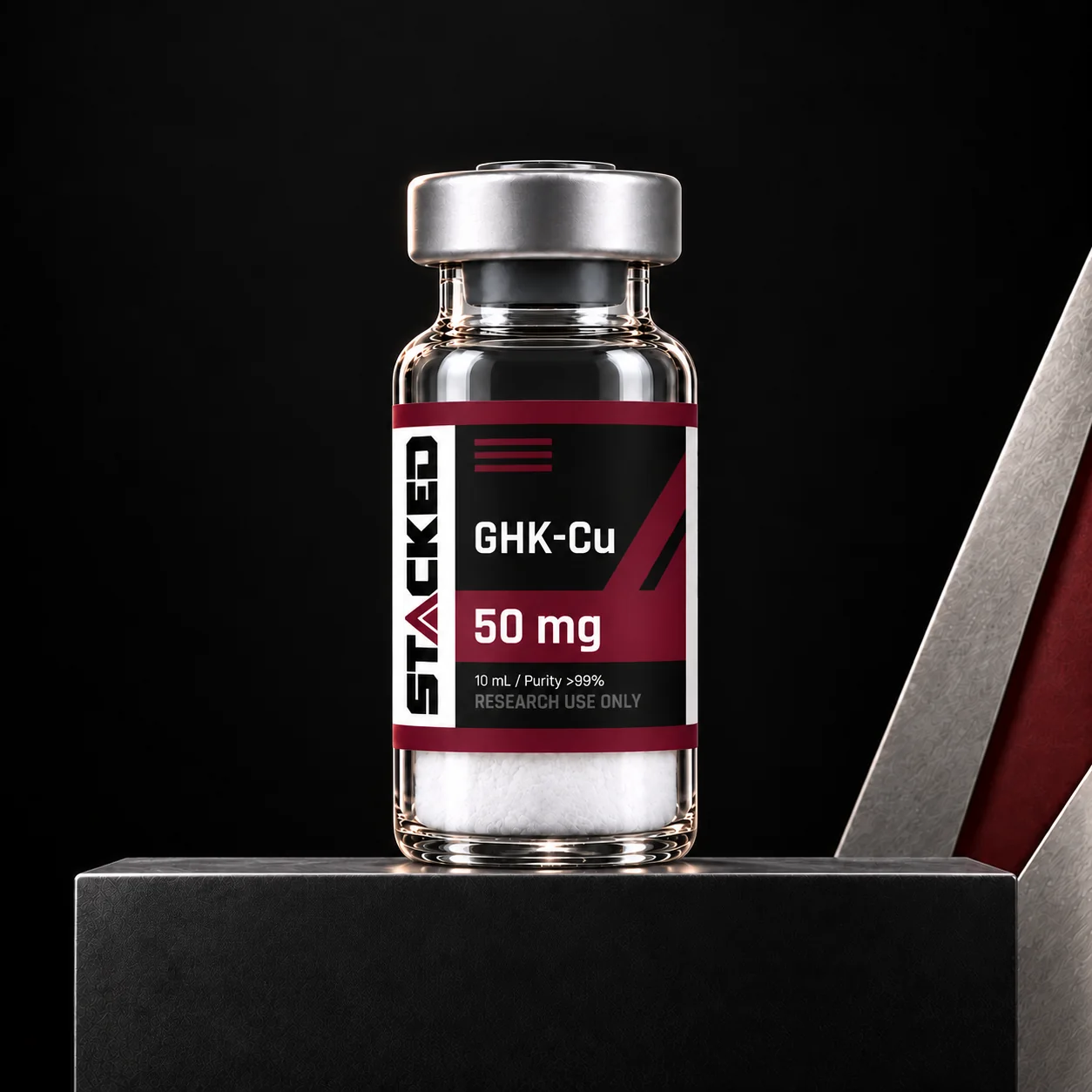
GHK-Cu (copper tripeptide-1) is the copper(II) complex of the naturally occurring tripeptide Gly-His-Lys, studied in skin, wound-healing and tissue-remodeling research. Supplied as a blue lyophilized powder in 50 mg and 100 mg vials, each lot with an HPLC certificate of analysis. CAS 49557-75-7. For laboratory research use only.
Certificate of analysisView available PDF reports
Product identification & intended use
SKU: STK-VIA-00066
For laboratory research use only. Not for human or veterinary use.
Description
GHK-Cu Vial: Research-Grade Copper Tripeptide-1
GHK-Cu is the copper(II) complex of the tripeptide glycyl-L-histidyl-L-lysine. It occurs naturally in human plasma, saliva and urine, binds copper with high affinity, and is one of the most studied peptides in skin, connective-tissue and gene-expression research.
Stacked BioLabs supplies GHK-Cu as a lyophilized powder in 50 mg and 100 mg vials, each with a lot-specific certificate of analysis.
Compound identity
Research background
GHK was identified in 1973 by Loren Pickart, who found that a factor in plasma from younger donors changed the behaviour of liver tissue from older donors. The active component turned out to be the tripeptide Gly-His-Lys, which binds copper tightly through its histidine and the peptide backbone. Plasma levels of GHK have been reported to decline with age.
Research on GHK-Cu covers several areas. In skin and wound models it has been associated with collagen and glycosaminoglycan synthesis, extracellular-matrix remodeling and the attraction of immune and endothelial cells. Later analyses of gene-expression databases suggested that GHK influences the activity of a large number of human genes, including ones involved in tissue repair and antioxidant defence, which broadened interest in it well beyond cosmetic science.
Because it binds copper, GHK-Cu is also used in studies of copper transport and delivery to cells. A capsule format is available, and GHK-Cu is the main component of the GLOW and KLOW research blends.
Verifying your lot
Every vial carries a lot number. Match it to its certificate in the COA & lab reports library, which lists identity and purity results for that specific batch. A certificate applies only to the lot it names. If you can’t find a report for your lot, contact us and we’ll supply it. Keep the certificate in your lab records together with the product, strength and lot number, so every result can be traced back to the exact batch used.
A typical certificate reports purity by high-performance liquid chromatography (HPLC) and confirms identity by mass spectrometry (MS), comparing the measured molecular mass with the expected value for the compound. Check that the product name, strength and lot number on the certificate match the label before recording results.
Storage and handling
Lyophilized peptides are most stable when kept cold, dry and away from light; −20 °C is the standard for long-term storage of lyophilized material. Follow the storage instructions supplied with the material and your institution’s handling procedures. Reconstitution is usually done with sterile or bacteriostatic water, depending on your protocol. Before opening, let the vial reach room temperature to limit condensation, and use sterile technique when puncturing the stopper. Label each reconstituted vial with the date, diluent and concentration used, and keep it refrigerated and protected from light.
Frequently asked questions
Why is GHK-Cu blue?
The copper(II) ion gives the complex, and its solutions, a characteristic blue colour.
What is the difference between GHK and GHK-Cu?
GHK is the free tripeptide. GHK-Cu is the tripeptide bound to a copper ion, the form most studied in the literature.
What strengths are available?
50 mg and 100 mg per vial. Choose a strength above to see its price and availability.
Is this product for human use?
No. This product is sold strictly for laboratory research use. It is not a drug, food, dietary supplement or cosmetic, and is not for human or veterinary use. See our RUO policy.
References
1. Pickart L, Margolina A. Regenerative and protective actions of the GHK-Cu peptide in the light of the new gene data. Int J Mol Sci. 2018. PubMed
2. Further reading: PubMed literature on GHK-Cu · PubChem
