
PRODUCT SPECIFICATIONS
- CAS #
- GHK-Cu Copper: 49557-75-7 / BPC-157: 137525-51-0 / TB-500: 885340-08-9 (acetylated 17–23 fragment)
- Molecular weight
- GHK-Cu Copper: 403.9 g/mol / BPC-157: ≈1419.5 g/mol / TB-500: 889.02 g/mol (Ac-LKKTETQ)
- Storage instructions
- Keep unopened dry material at −20 °C for long-term storage, protected from light and moisture, unless the supplied label specifies otherwise. After preparing a solution, follow the lot-specific instructions and your validated laboratory protocol.
Peptide Vials for Sale
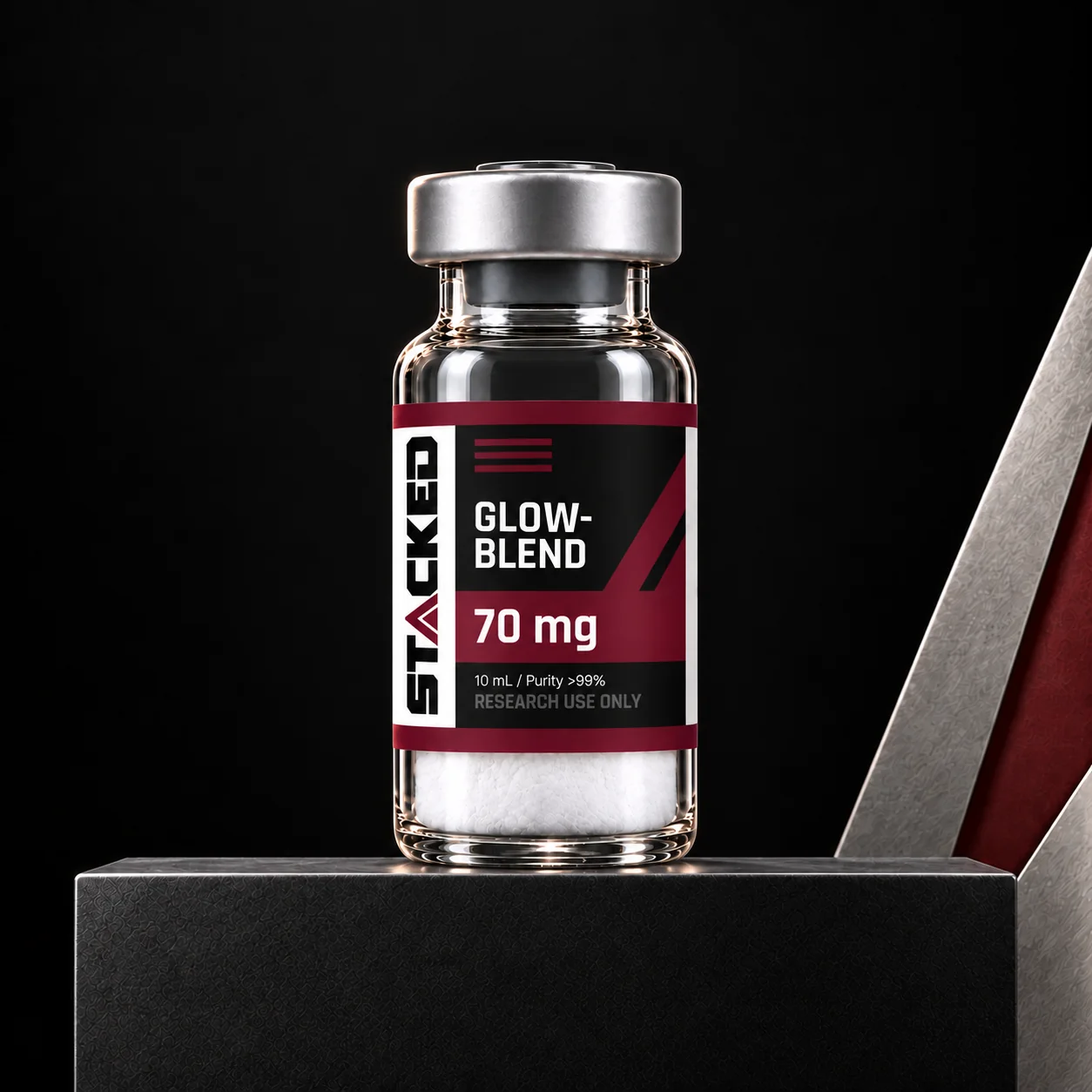
GLOW Peptide Blend Vial (70mg)
GLOW is a three-peptide research blend in one lyophilized vial: 50 mg GHK-Cu, 10 mg BPC-157 and 10 mg TB-500 (70 mg total), most often studied in skin and connective-tissue models. Each lot ships with an HPLC certificate of analysis. For laboratory research use only.
Available
Certificate of analysisView available PDF reports
Product identification & intended use
SKU: SB-VIAL-GlowBlend-70MG
For laboratory research use only. Not for human or veterinary use.
Description
GLOW Peptide Blend: GHK-Cu, BPC-157 and TB-500 in One Vial
GLOW is a three-peptide research blend of GHK-Cu, BPC-157 and TB-500, supplied together in a single lyophilized vial. The combination brings a copper-binding tripeptide and two tissue-repair research peptides into one lot, so all three can be studied from the same material.
Each 70 mg vial contains 50 mg GHK-Cu, 10 mg BPC-157 and 10 mg TB-500, with a lot-specific certificate of analysis.
Blend composition
| Compound | Amount per vial |
|---|---|
| GHK-Cu | 50 mg |
| BPC-157 | 10 mg |
| TB-500 | 10 mg |
| Total | 70 mg |
Why researchers pair these
GLOW combines three separately studied peptides at a fixed ratio: GHK-Cu, which makes up most of the vial and is studied in skin and connective-tissue models, plus BPC-157 and TB-500, studied in tissue-repair and cell-migration models. Researchers use it when a protocol calls for the three together from one lot.
Research background
GHK-Cu (glycyl-L-histidyl-L-lysine:copper) was first isolated from human plasma and is studied for its role in copper transport, extracellular-matrix remodeling and broad changes in gene expression. BPC-157 is a stable 15-amino-acid peptide derived from a gastric protein, investigated in tendon, ligament, muscle and gut-tissue models. TB-500 is a synthetic peptide based on thymosin β4, which regulates actin and is studied in cell-migration and wound models.
Researchers use GLOW when a protocol calls for the three compounds together at a fixed ratio. Because GHK-Cu makes up most of the vial by mass, the blend is often discussed in skin and connective-tissue research contexts.
A capsule version, GLOW Blend Capsules, is also available, as is the four-peptide KLOW blend, which adds KPV. Individual components include GHK-Cu and BPC-157.
Verifying your lot
Every vial carries a lot number. Match it to its certificate in the COA & lab reports library, which lists identity and purity results for that specific batch. A certificate applies only to the lot it names. If you can’t find a report for your lot, contact us and we’ll supply it. Keep the certificate in your lab records together with the product, strength and lot number, so every result can be traced back to the exact batch used.
A typical certificate reports purity by high-performance liquid chromatography (HPLC) and confirms identity by mass spectrometry (MS), comparing the measured molecular mass with the expected value for the compound. Check that the product name, strength and lot number on the certificate match the label before recording results.
Storage and handling
Lyophilized peptides are most stable when kept cold, dry and away from light; −20 °C is the standard for long-term storage of lyophilized material. Follow the storage instructions supplied with the material and your institution’s handling procedures. Reconstitution is usually done with sterile or bacteriostatic water, depending on your protocol. Before opening, let the vial reach room temperature to limit condensation, and use sterile technique when puncturing the stopper. Label each reconstituted vial with the date, diluent and concentration used, and keep it refrigerated and protected from light.
Frequently asked questions
Why is GHK-Cu the largest component?
The blend is formulated at 50 mg GHK-Cu to 10 mg each of BPC-157 and TB-500, reflecting the larger quantities typically used in GHK-Cu research.
Is the solution blue once reconstituted?
Copper peptides typically give a blue tint in solution. Colour alone is not a quality measure; use the lot COA.
What strengths are available?
One size: 70 mg per vial (50 mg GHK-Cu, 10 mg BPC-157, 10 mg TB-500).
Is this product for human use?
No. This product is sold strictly for laboratory research use. It is not a drug, food, dietary supplement or cosmetic, and is not for human or veterinary use. See our RUO policy.
References
1. Pickart L, Margolina A. Regenerative and protective actions of the GHK-Cu peptide in the light of the new gene data. Int J Mol Sci. 2018. PubMed
2. Goldstein AL, et al. Thymosin β4: actin-sequestering protein moonlights to repair injured tissues. Trends Mol Med. 2005. PubMed
3. Further reading: PubMed literature on GHK-Cu
