
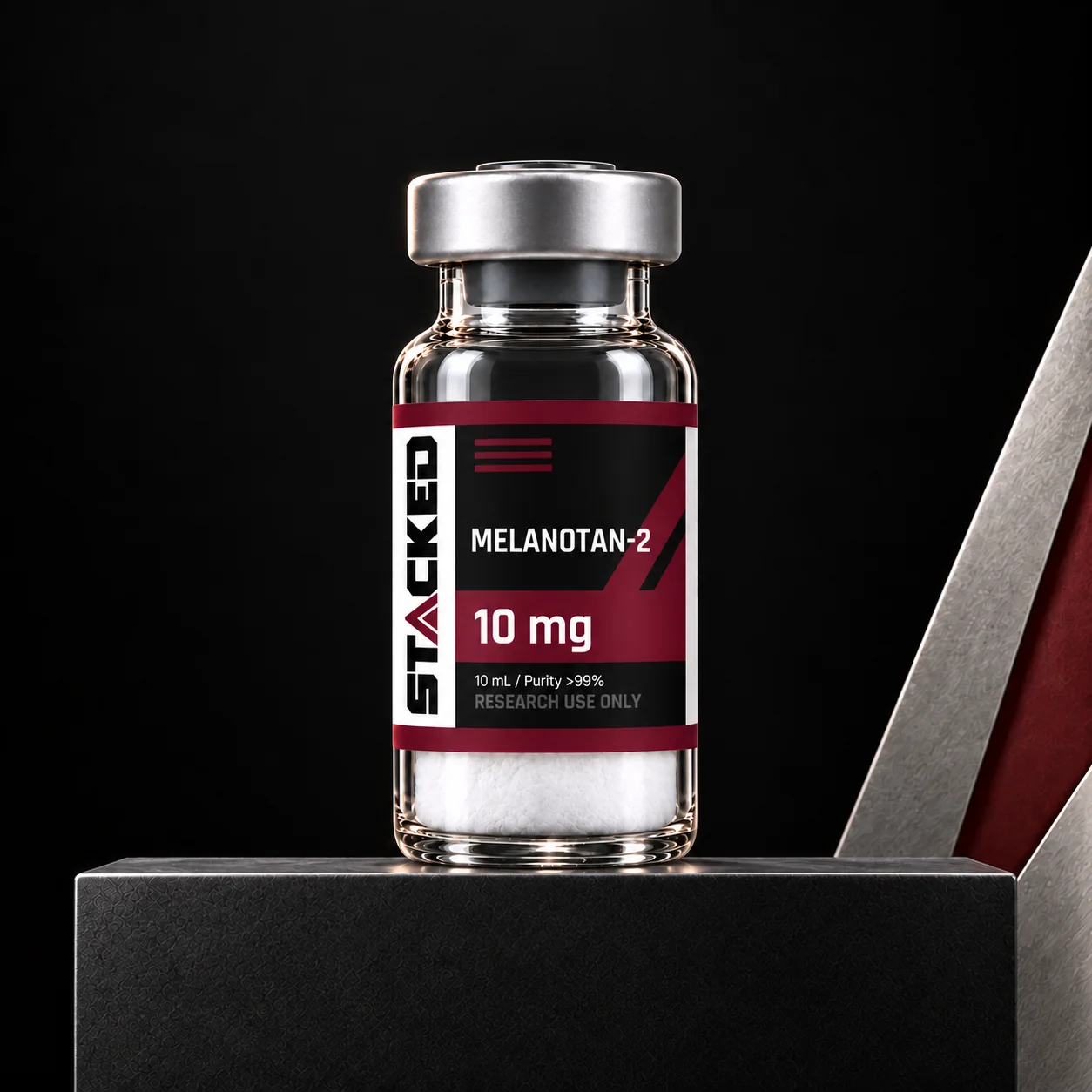
PRODUCT SPECIFICATIONS
- CAS #
- 121062-08-6
- Molecular weight
- ≈1024.2 g/mol
- Storage instructions
- Keep unopened dry material at −20 °C for long-term storage, protected from light and moisture, unless the supplied label specifies otherwise. After preparing a solution, follow the lot-specific instructions and your validated laboratory protocol.
Peptide Vials for Sale
Melanotan 2 Vial (10mg)
Melanotan 2 (melanotan II, MT-II) is a synthetic cyclic heptapeptide analogue of α-MSH that activates several melanocortin receptors (MC1R, MC3R, MC4R), used as a broad tool in melanocortin-system research. Supplied as lyophilized powder in a 10 mg vial, each lot with an HPLC certificate of analysis. CAS 121062-08-6. For laboratory research use only.
Available
Certificate of analysisView available PDF reports
Product identification & intended use
SKU: SB-VIAL-MT2-10MG
For laboratory research use only. Not for human or veterinary use.
Description
Melanotan 2 Vial: Research-Grade Cyclic Melanocortin Agonist
Melanotan 2 (melanotan II, MT-II) is a synthetic cyclic heptapeptide analogue of alpha-melanocyte-stimulating hormone (α-MSH). It activates several melanocortin receptors, including MC1R in pigment cells and MC3R and MC4R in the brain, which makes it a broad tool for studying the melanocortin system.
Stacked BioLabs supplies Melanotan 2 as a lyophilized powder, 10 mg per vial, with a lot-specific certificate of analysis.
Compound identity
Research background
Melanotan 2 was developed at the University of Arizona in the 1990s by a group looking for stable α-MSH analogues. Native α-MSH is broken down within minutes; cyclizing the core sequence through a lactam bridge, substituting D-phenylalanine and replacing methionine with norleucine produced a much more potent and durable molecule, described in early work as a “superpotent” melanotropin.
Because it is not selective, MT-II has been used to study several melanocortin functions at once. Research covers MC1R-driven melanogenesis in skin cells, and MC4R signaling in the hypothalamus, which is involved in appetite, energy balance and sexual function. That broad activity is also why later work produced more selective compounds.
One of those successors is bremelanotide, known in research as PT-141, a metabolite-derived analogue with a free acid C-terminus that was developed to study melanocortin effects without the same emphasis on pigmentation. For α-MSH-related research without melanocortin receptor agonism, see KPV.
Verifying your lot
Every vial carries a lot number. Match it to its certificate in the COA & lab reports library, which lists identity and purity results for that specific batch. A certificate applies only to the lot it names. If you can’t find a report for your lot, contact us and we’ll supply it. Keep the certificate in your lab records together with the product, strength and lot number, so every result can be traced back to the exact batch used.
A typical certificate reports purity by high-performance liquid chromatography (HPLC) and confirms identity by mass spectrometry (MS), comparing the measured molecular mass with the expected value for the compound. Check that the product name, strength and lot number on the certificate match the label before recording results.
Storage and handling
Lyophilized peptides are most stable when kept cold, dry and away from light; −20 °C is the standard for long-term storage of lyophilized material. Follow the storage instructions supplied with the material and your institution’s handling procedures. Reconstitution is usually done with sterile or bacteriostatic water, depending on your protocol. Before opening, let the vial reach room temperature to limit condensation, and use sterile technique when puncturing the stopper. Label each reconstituted vial with the date, diluent and concentration used, and keep it refrigerated and protected from light.
Frequently asked questions
How is Melanotan 2 different from PT-141?
PT-141 (bremelanotide) is closely related to Melanotan 2 but ends in a free acid rather than an amide. It was developed as a more targeted research and clinical compound.
Which receptors does Melanotan 2 act on?
It is a non-selective agonist at MC1R, MC3R, MC4R and MC5R.
What strengths are available?
One size: 10 mg per vial.
Is this product for human use?
No. This product is sold strictly for laboratory research use. It is not a drug, food, dietary supplement or cosmetic, and is not for human or veterinary use. See our RUO policy.
References
1. Dorr RT, et al. Evaluation of melanotan-II, a superpotent cyclic melanotropic peptide in a pilot phase-I clinical study. Life Sci. 1996. PubMed
2. Further reading: PubMed literature on Melanotan II · PubChem
