
PRODUCT SPECIFICATIONS
- CAS #
- 946870-92-4
- Molecular weight
- ≈9111 g/mol
- Storage instructions
- Keep unopened dry material at −20 °C for long-term storage, protected from light and moisture, unless the supplied label specifies otherwise. After preparing a solution, follow the lot-specific instructions and your validated laboratory protocol.
Peptide Vials for Sale
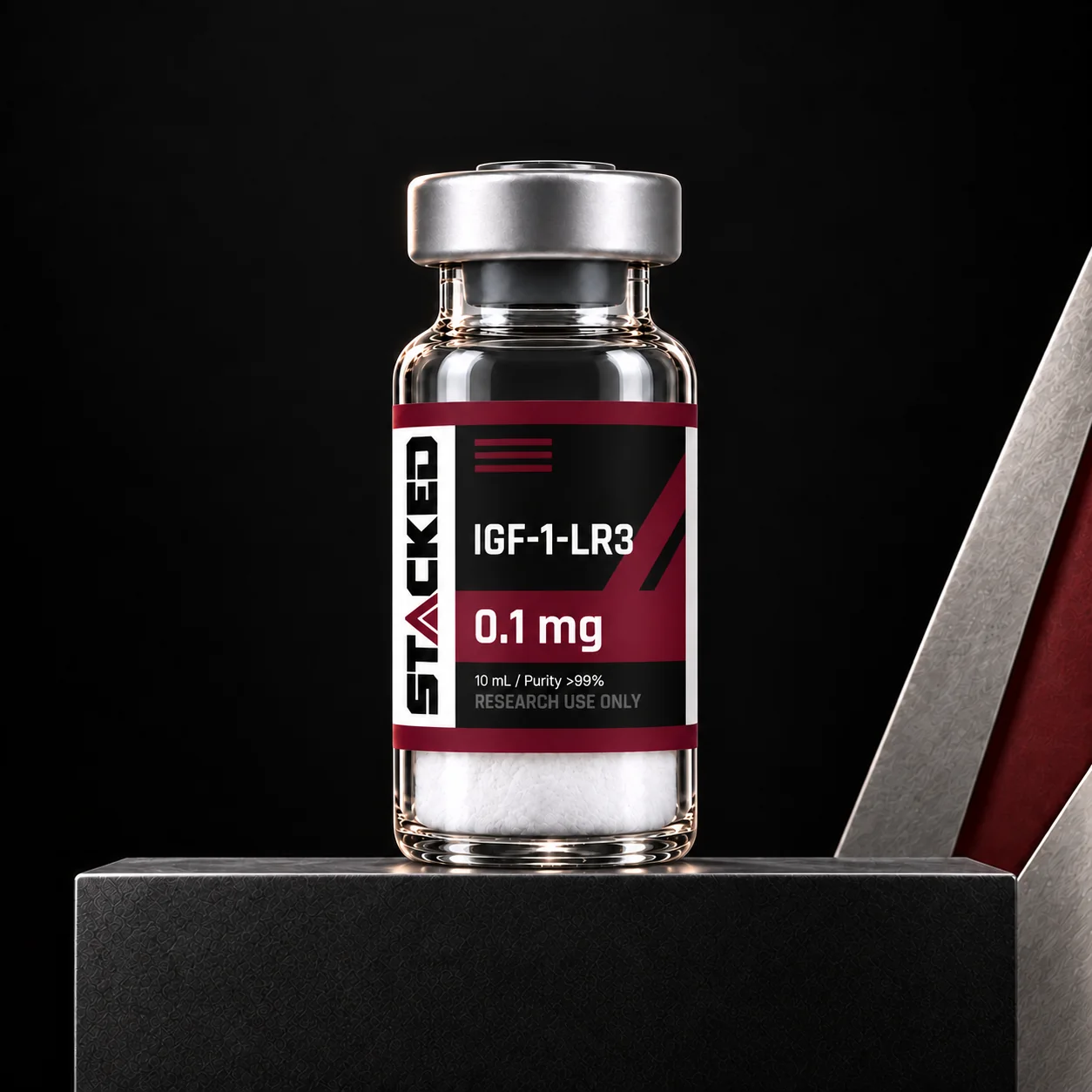
IGF-1 LR3 Vial
IGF-1 LR3 (Long R3 IGF-1) is an 83-amino-acid analogue of insulin-like growth factor-1 with an Arg3 substitution and a 13-residue N-terminal extension, which sharply reduces binding to IGF-binding proteins. Supplied as lyophilized powder in 0.1 mg and 1 mg vials, each lot with an HPLC certificate of analysis. CAS 946870-92-4. For laboratory research use only.
Certificate of analysisView available PDF reports
Product identification & intended use
SKU: STK-VIA-00071
For laboratory research use only. Not for human or veterinary use.
Description
IGF-1 LR3 Vial: Research-Grade Long R3 Insulin-Like Growth Factor-1
IGF-1 LR3 (Long R3 IGF-1) is an 83-amino-acid analogue of human insulin-like growth factor-1. It carries an arginine in place of glutamic acid at position 3 and a 13-residue N-terminal extension, changes that sharply reduce binding to IGF-binding proteins while keeping activity at the IGF-1 receptor.
Stacked BioLabs supplies IGF-1 LR3 as a lyophilized powder in 0.1 mg and 1 mg vials, each with a lot-specific certificate of analysis.
Compound identity
Research background
Native IGF-1 is a 70-amino-acid hormone that circulates mostly bound to a family of six IGF-binding proteins (IGFBPs), which limit how much is free to reach its receptor. The Long R3 analogue was engineered in the early 1990s to test how much IGFBP binding restricts IGF-1 activity. With binding-protein interaction greatly reduced, it proved considerably more potent than native IGF-1 in cell-culture assays.
That potency made IGF-1 LR3 a widely used reagent in cell biology and biomanufacturing, where it is added to serum-free culture media to support the growth of mammalian cells such as CHO lines. In research on muscle, bone and metabolism, it is used to study IGF-1 receptor signaling through the PI3K/Akt and MAPK pathways without the confounding effects of binding proteins.
Because it is a large protein, IGF-1 LR3 is more sensitive to handling than short peptides; avoid repeated freeze-thaw cycles. A liquid IGF-1 LR3 spray is also available. For upstream growth hormone axis research, see sermorelin and tesamorelin.
Verifying your lot
Every vial carries a lot number. Match it to its certificate in the COA & lab reports library, which lists identity and purity results for that specific batch. A certificate applies only to the lot it names. If you can’t find a report for your lot, contact us and we’ll supply it. Keep the certificate in your lab records together with the product, strength and lot number, so every result can be traced back to the exact batch used.
A typical certificate reports purity by high-performance liquid chromatography (HPLC) and confirms identity by mass spectrometry (MS), comparing the measured molecular mass with the expected value for the compound. Check that the product name, strength and lot number on the certificate match the label before recording results.
Storage and handling
Lyophilized peptides are most stable when kept cold, dry and away from light; −20 °C is the standard for long-term storage of lyophilized material. Follow the storage instructions supplied with the material and your institution’s handling procedures. Reconstitution is usually done with sterile or bacteriostatic water, depending on your protocol. Before opening, let the vial reach room temperature to limit condensation, and use sterile technique when puncturing the stopper. Label each reconstituted vial with the date, diluent and concentration used, and keep it refrigerated and protected from light.
Frequently asked questions
Why is IGF-1 LR3 more potent than IGF-1 in cell culture?
Its modifications greatly reduce binding to IGF-binding proteins, leaving more of it free to activate the IGF-1 receptor.
What does “R3” mean?
It refers to the arginine (R) substituted for glutamic acid at position 3 of the IGF-1 sequence.
What strengths are available?
0.1 mg and 1 mg per vial. Choose a strength above to see its price and availability.
Is this product for human use?
No. This product is sold strictly for laboratory research use. It is not a drug, food, dietary supplement or cosmetic, and is not for human or veterinary use. See our RUO policy.
References
1. Francis GL, et al. Novel recombinant fusion protein analogues of insulin-like growth factor (IGF)-I indicate the relative importance of IGF-binding protein and receptor binding for enhanced biological potency. J Mol Endocrinol. 1992. PubMed
2. Further reading: PubMed literature on Long R3 IGF-1
