
PRODUCT SPECIFICATIONS
- CAS #
- 86168-78-7 (free base); 114466-38-5 (acetate)
- Molecular weight
- ≈3357.9 g/mol
- Storage instructions
- Keep unopened dry material at −20 °C for long-term storage, protected from light and moisture, unless the supplied label specifies otherwise. After preparing a solution, follow the lot-specific instructions and your validated laboratory protocol.
Peptide Vials for Sale
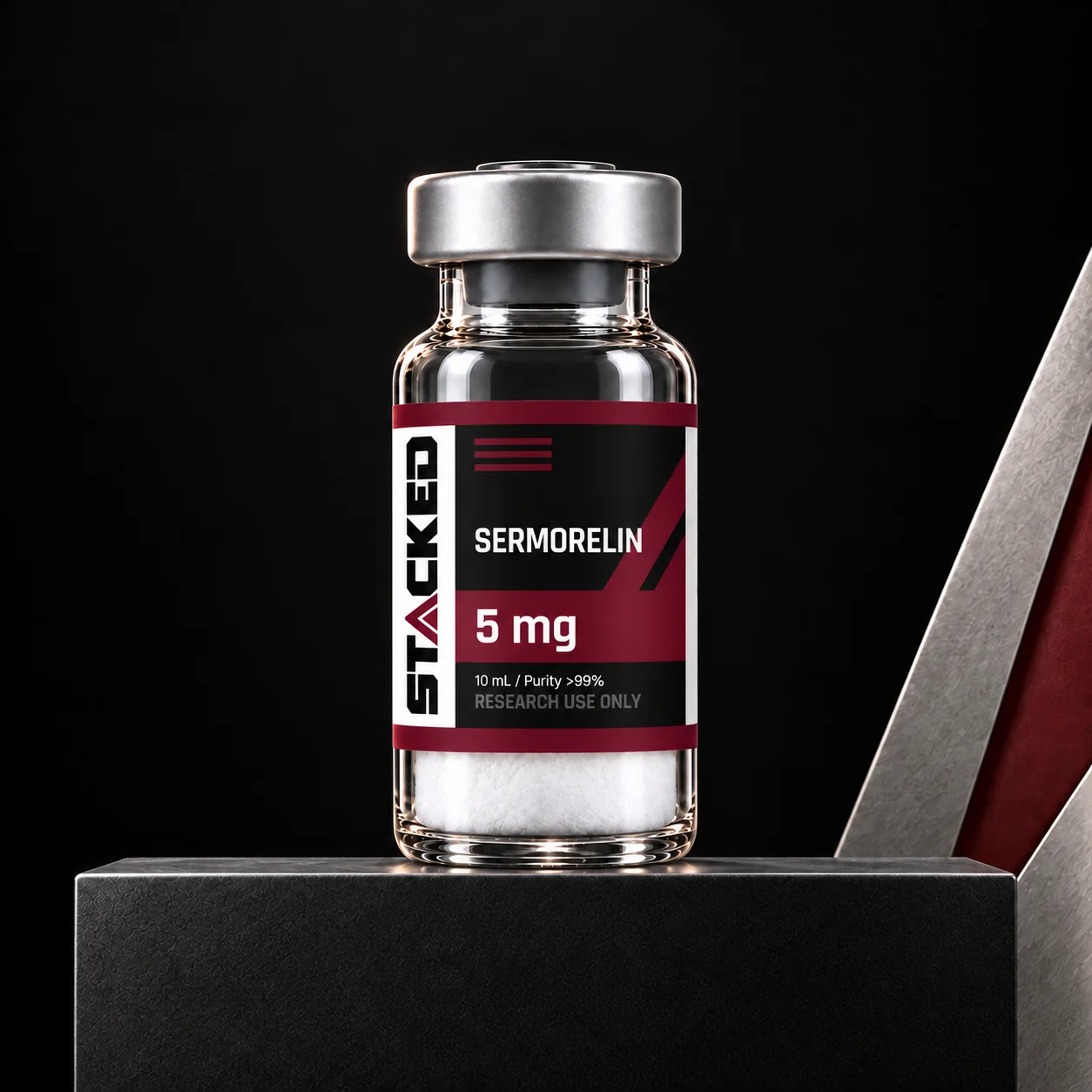
Sermorelin Peptide Vial
Sermorelin (GRF 1-29 NH₂) is the 29-amino-acid active fragment of growth hormone-releasing hormone, used in research on the GHRH receptor and the pituitary growth-hormone axis. Supplied as lyophilized powder in 5 mg and 10 mg vials, labeled >99% purity by HPLC with a lot-matched certificate of analysis. CAS 86168-78-7. For laboratory research use only.
Certificate of analysisView available PDF reports
Product identification & intended use
SKU: STK-VIA-00101
For laboratory research use only. Not for human or veterinary use.
Description
Sermorelin Vial: Research-Grade GHRH (1-29) Analogue
Sermorelin is a synthetic 29-amino-acid peptide that reproduces the N-terminal fragment of human growth hormone-releasing hormone (GHRH). The native hormone is 44 residues long; the 1–29 segment is the shortest sequence that keeps full biological activity at the GHRH receptor, which makes it a standard reference compound for research into the hypothalamic–pituitary growth hormone axis.
Stacked BioLabs supplies sermorelin as a lyophilized powder in a sealed vial, in 5 mg and 10 mg strengths. Each lot has its own certificate of analysis.
Compound identity
Research background
Sermorelin binds the GHRH receptor on pituitary somatotroph cells, where it stimulates the synthesis and release of endogenous growth hormone. This separates it from studies that introduce growth hormone directly: the peptide works upstream, so the pituitary’s own pulsatile release pattern and feedback regulation stay in place.
The molecule has a long published record. It was approved by the FDA in 1997 under the brand name Geref for pediatric growth hormone deficiency, and was discontinued by its manufacturer in 2008 for commercial reasons. Published work covers its pharmacology in diagnostic stimulation testing, comparisons with other growth hormone secretagogues, and its role in studying age-related changes in the GH/IGF-1 axis. Because the 1–29 fragment is short and unmodified, it is also a common baseline when comparing longer-acting analogues engineered for enzymatic stability.
In laboratory research, it is often studied alongside ghrelin-receptor agonists such as ipamorelin. The two classes act on different receptors, which makes the pairing useful for studying how the GHRH and ghrelin pathways interact. Related GHRH analogues in the catalog include CJC-1295 (no DAC) and tesamorelin.
Verifying your lot
Every vial carries a lot number. Match it to its certificate in the COA & lab reports library, which lists identity and purity results for that specific batch. A certificate applies only to the lot it names. If you can’t find a report for your lot, contact us and we’ll supply it. Keep the certificate in your lab records together with the vial’s strength and lot number, so every result can be traced back to the exact batch used.
Storage and handling
Lyophilized peptides are most stable when kept cold, dry and away from light; −20 °C is the standard for long-term storage of lyophilized material. Follow the storage instructions supplied with the material and your institution’s handling procedures. Reconstitution is usually done with sterile or bacteriostatic water, depending on your protocol.
Frequently asked questions
What is the difference between sermorelin and GHRH?
Native GHRH is 44 amino acids long. The peptide is its first 29 residues, amidated at the C-terminus, and keeps the receptor-binding activity of the full hormone.
How is sermorelin different from CJC-1295?
Both are GHRH (1-29) analogues. CJC-1295 carries amino-acid substitutions designed to resist enzymatic breakdown, giving it a longer half-life in research models than the unmodified 1–29 fragment.
What strengths are available?
5 mg and 10 mg per vial. Choose a strength above to see its price and availability.
Is this product for human use?
No. This product is sold strictly for laboratory research use. It is not a drug, food or cosmetic, and is not for human or veterinary use. See our RUO policy.
References
1. Prakash A, Goa KL. Sermorelin: a review of its use in the diagnosis and treatment of children with idiopathic growth hormone deficiency. BioDrugs. 1999;12(2):139–57. PubMed
2. Walker RF. Sermorelin: a better approach to management of adult-onset growth hormone insufficiency? Clin Interv Aging. 2006;1(4):307–8. PubMed
3. PubChem CID 16129620 — Sermorelin. PubChem
