
PRODUCT SPECIFICATIONS
- CAS #
- 885340-08-9 (acetylated 17–23 fragment)
- Molecular weight
- 889.02 g/mol (Ac-LKKTETQ)
- Storage instructions
- Keep the original bottle tightly closed in a cool, dry place, protected from light and moisture. Follow any additional storage instructions on the label.
Peptide Capsules for Sale
TB-500 Capsules
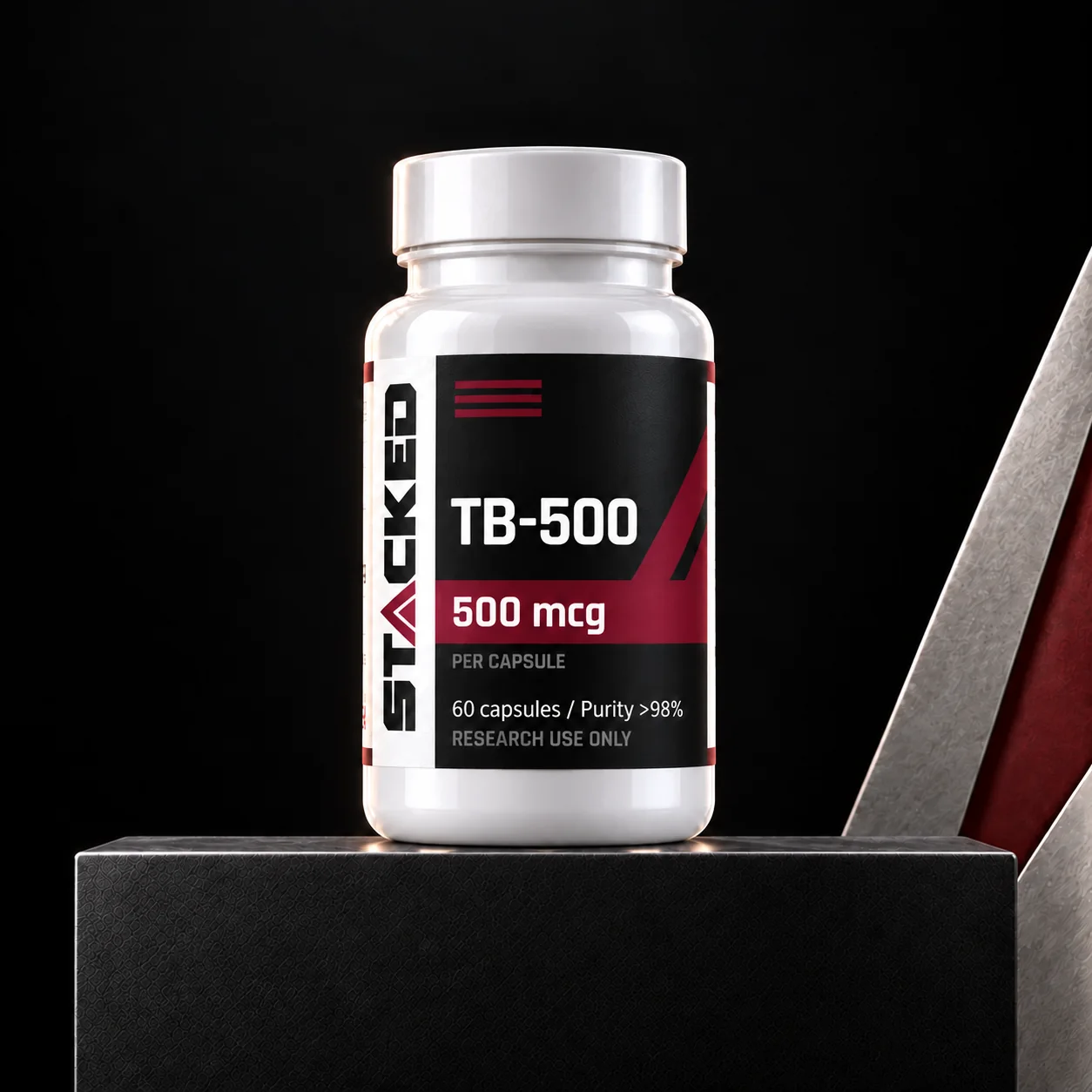
TB-500 is a synthetic research peptide based on thymosin beta-4, the main actin-binding protein in cells, studied for its role in cell migration, blood-vessel formation and tissue repair. 60 capsules of 500 mcg per bottle, each lot with an HPLC certificate of analysis. For laboratory research use only.
Available
Certificate of analysisView available PDF reports
Product identification & intended use
SKU: SB-CAPS-TB500-500MCG
For laboratory research use only. Not for human or veterinary use.
Description
TB-500 Capsules: Thymosin Beta-4-Based Research Peptide
TB-500 is a synthetic research peptide based on thymosin beta-4 (Tβ4), a 43-amino-acid protein found in almost every human cell. Thymosin beta-4 is the main protein that binds and stores G-actin, the building block of the cell’s internal skeleton, and it is studied for its role in cell migration, blood-vessel formation and tissue repair.
Stacked BioLabs supplies TB-500 in bottles of 60 capsules, 500 mcg per capsule, with a lot-specific certificate of analysis.
Compound identity
Research background
Thymosin beta-4 was first isolated from thymus extracts, but it turned out to be present in nearly all tissues, where it binds free actin monomers and releases them as cells need to change shape and move. That link to cell movement led researchers to study it in wound healing, and published animal studies have examined Tβ4 in skin wounds, corneal injury, heart muscle after infarction and hair-follicle models.
Much of Tβ4’s actin-binding and cell-migration activity has been mapped to a short central motif, LKKTETQ. “TB-500” is the name used in the research-chemical field for synthetic peptides based on Tβ4 and this region, so the exact composition can differ between suppliers; the lot COA is the authoritative record of what a given batch contains. Separately, the N-terminal fragment Ac-SDKP, released from Tβ4, has its own literature on anti-fibrotic activity.
TB-500 is most often researched together with BPC-157, and the catalog offers BPC-157 + TB-500 capsules, a blend vial, and the GLOW blend with GHK-Cu.
Verifying your lot
Every bottle carries a lot number. Match it to its certificate in the COA & lab reports library, which lists identity and purity results for that specific batch. A certificate applies only to the lot it names. If you can’t find a report for your lot, contact us and we’ll supply it. Keep the certificate in your lab records together with the product, strength and lot number, so every result can be traced back to the exact batch used.
A typical certificate reports purity by high-performance liquid chromatography (HPLC) and confirms identity by mass spectrometry (MS), comparing the measured molecular mass with the expected value for the compound. Check that the product name, strength and lot number on the certificate match the label before recording results.
Storage and handling
Keep the bottle tightly closed in a cool, dry place, away from light and moisture, and follow the storage instructions on the label. Record the lot number and the date the bottle is first opened so every use can be traced in your laboratory records. Do not transfer capsules into unlabeled containers, and keep the original bottle and its label with the material until the lot is used up or retired from your study.
Frequently asked questions
Is TB-500 the same as thymosin beta-4?
TB-500 is a synthetic research peptide based on thymosin beta-4 and its actin-binding region. Check the lot COA for the exact composition of each batch.
Is thymosin beta-4 related to thymosin alpha-1?
No. Despite the shared name, they are unrelated peptides with different functions.
What does each bottle contain?
60 capsules per bottle, 500 mcg TB-500 per capsule.
Is this product for human use?
No. This product is sold strictly for laboratory research use. It is not a drug, food, dietary supplement or cosmetic, and is not for human or veterinary use. See our RUO policy.
References
1. Goldstein AL, et al. Thymosin β4: actin-sequestering protein moonlights to repair injured tissues. Trends Mol Med. 2005. PubMed
2. Further reading: PubMed literature on thymosin β4
