
PRODUCT SPECIFICATIONS
- CAS #
- 210302-17-3
- Molecular weight
- ≈340.3 g/mol
- Storage instructions
- Keep the original bottle tightly closed in a cool, dry place, protected from light and moisture. Follow any additional storage instructions on the label.
Peptide Capsules for Sale
BAM-15 Capsules
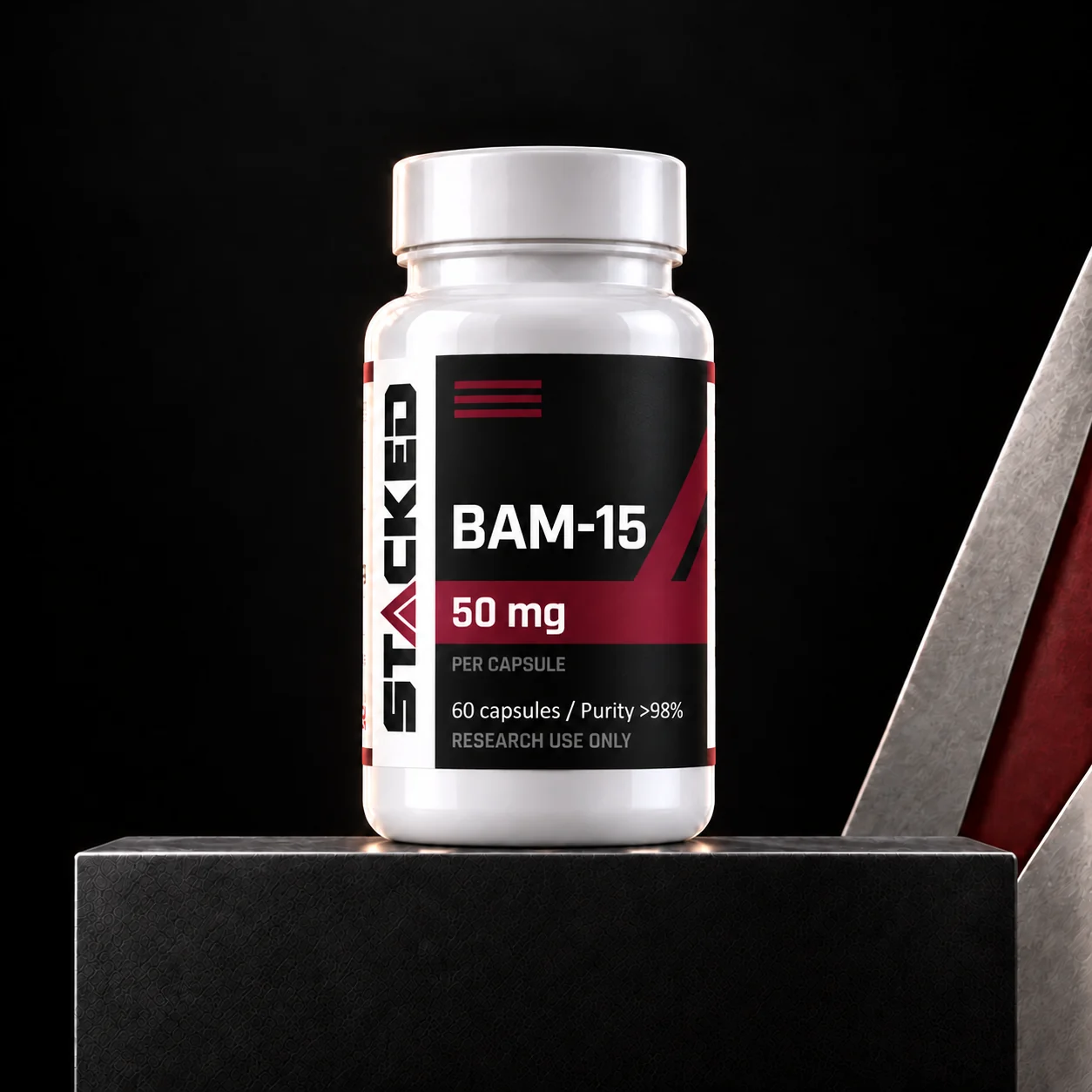
BAM-15 (BAM15) is a small-molecule mitochondrial protonophore uncoupler — not a peptide — notable in research for uncoupling mitochondria without depolarizing the cell’s plasma membrane. 60 capsules of 50 mg per bottle, each lot with an HPLC certificate of analysis. CAS 210302-17-3. For laboratory research use only.
Available
Certificate of analysisView available PDF reports
Product identification & intended use
SKU: SB-CAPS-BAM15-50MG
For laboratory research use only. Not for human or veterinary use.
Description
BAM-15 Capsules: Research-Grade Mitochondrial Uncoupler
BAM-15 is a small-molecule mitochondrial protonophore uncoupler. It carries protons back across the inner mitochondrial membrane without passing through ATP synthase, so cells burn more fuel to maintain their energy supply. What makes it notable in research is that it does this without depolarizing the cell’s outer plasma membrane, a problem with older uncouplers.
Stacked BioLabs supplies BAM-15 in bottles of 60 capsules, 50 mg per capsule, with a lot-specific certificate of analysis.
Compound identity
Research background
Uncouplers have a long history in metabolism research. The classic example, 2,4-dinitrophenol (DNP), increases energy expenditure but also acts on other cell membranes and has a narrow margin between effective and toxic doses in animal studies. Researchers at the University of Virginia identified BAM15 in 2014 while screening for uncouplers that act selectively on mitochondria, and reported that it sustained high respiration rates in cells without affecting plasma-membrane potential.
Subsequent studies in mice fed a high-fat diet reported that BAM15 reduced fat mass and improved glucose and insulin handling without changing food intake or lean mass, and it has since been examined in models of fatty liver, sepsis and kidney injury. A practical limitation noted in the literature is its short half-life and low water solubility, which have prompted work on related analogues.
In the catalog, BAM-15 is often studied alongside other energy-expenditure research compounds such as SLU-PP-332, MOTS-c and 5-Amino-1MQ.
Verifying your lot
Every bottle carries a lot number. Match it to its certificate in the COA & lab reports library, which lists identity and purity results for that specific batch. A certificate applies only to the lot it names. If you can’t find a report for your lot, contact us and we’ll supply it. Keep the certificate in your lab records together with the product, strength and lot number, so every result can be traced back to the exact batch used.
A typical certificate reports purity by high-performance liquid chromatography (HPLC) and confirms identity by mass spectrometry (MS), comparing the measured molecular mass with the expected value for the compound. Check that the product name, strength and lot number on the certificate match the label before recording results.
Storage and handling
Keep the bottle tightly closed in a cool, dry place, away from light and moisture, and follow the storage instructions on the label. Record the lot number and the date the bottle is first opened so every use can be traced in your laboratory records. Do not transfer capsules into unlabeled containers, and keep the original bottle and its label with the material until the lot is used up or retired from your study.
Frequently asked questions
What is a mitochondrial uncoupler?
A compound that lets protons leak back into the mitochondrial matrix without making ATP, so more fuel is oxidized to meet the cell’s energy needs.
How does BAM-15 differ from DNP?
In published studies BAM-15 acted selectively on mitochondria without depolarizing the plasma membrane, unlike DNP.
What does each bottle contain?
60 capsules per bottle, 50 mg BAM-15 per capsule.
Is this product for human use?
No. This product is sold strictly for laboratory research use. It is not a drug, food, dietary supplement or cosmetic, and is not for human or veterinary use. See our RUO policy.
References
1. Kenwood BM, et al. Identification of a novel mitochondrial uncoupler that does not depolarize the plasma membrane. Mol Metab. 2014. PubMed
2. Further reading: PubMed literature on BAM15 · PubChem
