
PRODUCT SPECIFICATIONS
- CAS #
- 53-84-9
- Molecular weight
- ≈663.4 g/mol
- Storage instructions
- Keep unopened dry material at −20 °C for long-term storage, protected from light and moisture, unless the supplied label specifies otherwise. After preparing a solution, follow the lot-specific instructions and your validated laboratory protocol.
Peptide Vials for Sale
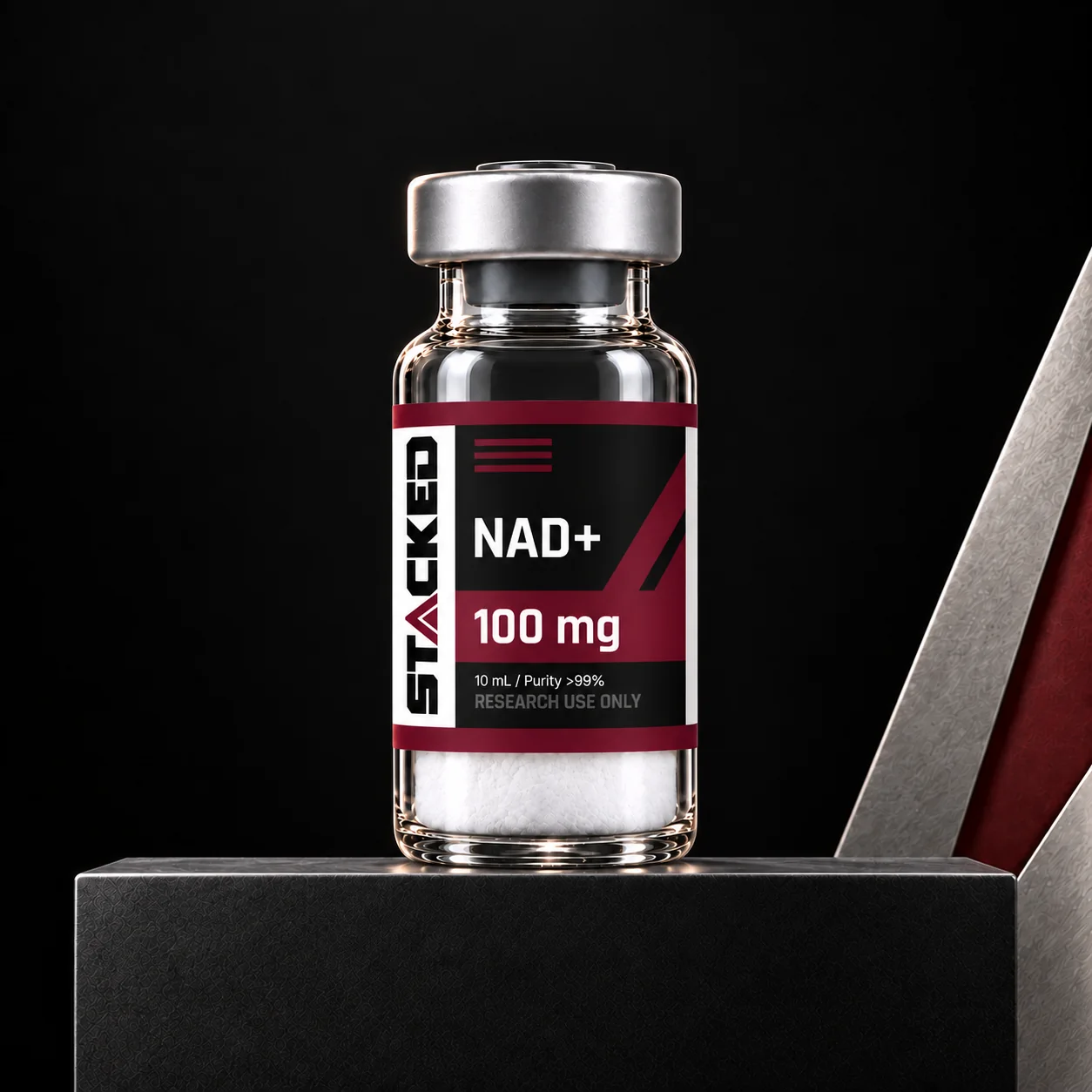
NAD+ Vial
NAD+ (β-nicotinamide adenine dinucleotide) is the coenzyme at the centre of cellular energy metabolism and the substrate for sirtuins, PARPs and CD38, studied in DNA-repair and aging research. Supplied as lyophilized powder in 100 mg, 500 mg and 1000 mg vials, each lot with an HPLC certificate of analysis. CAS 53-84-9. For laboratory research use only.
Certificate of analysisView available PDF reports
NAD+ 500 mg
Product identification & intended use
SKU: STK-VIA-00086
For laboratory research use only. Not for human or veterinary use.
Description
NAD+ Vial: Research-Grade Nicotinamide Adenine Dinucleotide
NAD+ (nicotinamide adenine dinucleotide, oxidized form) is a coenzyme found in every living cell. It carries electrons in energy metabolism and is consumed as a substrate by sirtuins, PARP enzymes and CD38, which places it at the centre of research on cellular energy, DNA repair and aging.
Stacked BioLabs supplies NAD+ as a lyophilized powder in 100 mg, 500 mg and 1000 mg vials, each with a lot-specific certificate of analysis.
Compound identity
Research background
Inside cells, NAD+ cycles between its oxidized form and its reduced form, NADH, as it moves electrons through glycolysis, the citric acid cycle and the mitochondrial electron transport chain. Separately, several enzyme families break NAD+ down as part of their reactions: sirtuins use it to remove acetyl groups from proteins, PARPs use it to signal and repair DNA damage, and CD38 degrades it in immune and other cells.
Studies in animal models and human tissue report that NAD+ levels fall with age in several tissues. That observation has driven a large body of research into ways of restoring NAD+, including its precursors nicotinamide riboside (NR) and nicotinamide mononucleotide (NMN), and direct NAD+ in cell culture and other experimental systems.
NAD+ is also a standard reagent in enzyme assays that measure dehydrogenase activity by tracking the NAD+/NADH ratio. A liquid NAD+ spray is available, and related metabolic research compounds include 5-Amino-1MQ, which targets an enzyme in the NAD+ salvage pathway, and MOTS-c.
Verifying your lot
Every vial carries a lot number. Match it to its certificate in the COA & lab reports library, which lists identity and purity results for that specific batch. A certificate applies only to the lot it names. If you can’t find a report for your lot, contact us and we’ll supply it. Keep the certificate in your lab records together with the product, strength and lot number, so every result can be traced back to the exact batch used.
A typical certificate reports purity by high-performance liquid chromatography (HPLC) and confirms identity by mass spectrometry (MS), comparing the measured molecular mass with the expected value for the compound. Check that the product name, strength and lot number on the certificate match the label before recording results.
Storage and handling
Lyophilized peptides are most stable when kept cold, dry and away from light; −20 °C is the standard for long-term storage of lyophilized material. Follow the storage instructions supplied with the material and your institution’s handling procedures. Reconstitution is usually done with sterile or bacteriostatic water, depending on your protocol. Before opening, let the vial reach room temperature to limit condensation, and use sterile technique when puncturing the stopper. Label each reconstituted vial with the date, diluent and concentration used, and keep it refrigerated and protected from light.
Frequently asked questions
What is the difference between NAD+ and NADH?
NAD+ is the oxidized form that accepts electrons; NADH is the reduced form that carries them. Cells continually convert one into the other.
How does NAD+ relate to NMN and NR?
NMN and NR are precursors that cells convert into NAD+. They are studied as indirect ways of raising NAD+ levels.
What strengths are available?
100 mg, 500 mg and 1000 mg per vial. Choose a strength above to see its price and availability.
Is this product for human use?
No. This product is sold strictly for laboratory research use. It is not a drug, food, dietary supplement or cosmetic, and is not for human or veterinary use. See our RUO policy.
References
1. Rajman L, Chwalek K, Sinclair DA. Therapeutic potential of NAD-boosting molecules: the in vivo evidence. Cell Metab. 2018. PubMed
2. Further reading: PubMed literature on NAD+ · PubChem
