
PRODUCT SPECIFICATIONS
- CAS #
- 221231-10-3
- Molecular weight
- ≈1815.1 g/mol
- Storage instructions
- Keep unopened dry material at −20 °C for long-term storage, protected from light and moisture, unless the supplied label specifies otherwise. After preparing a solution, follow the lot-specific instructions and your validated laboratory protocol.
Peptide Vials for Sale
AOD-9604 Vial
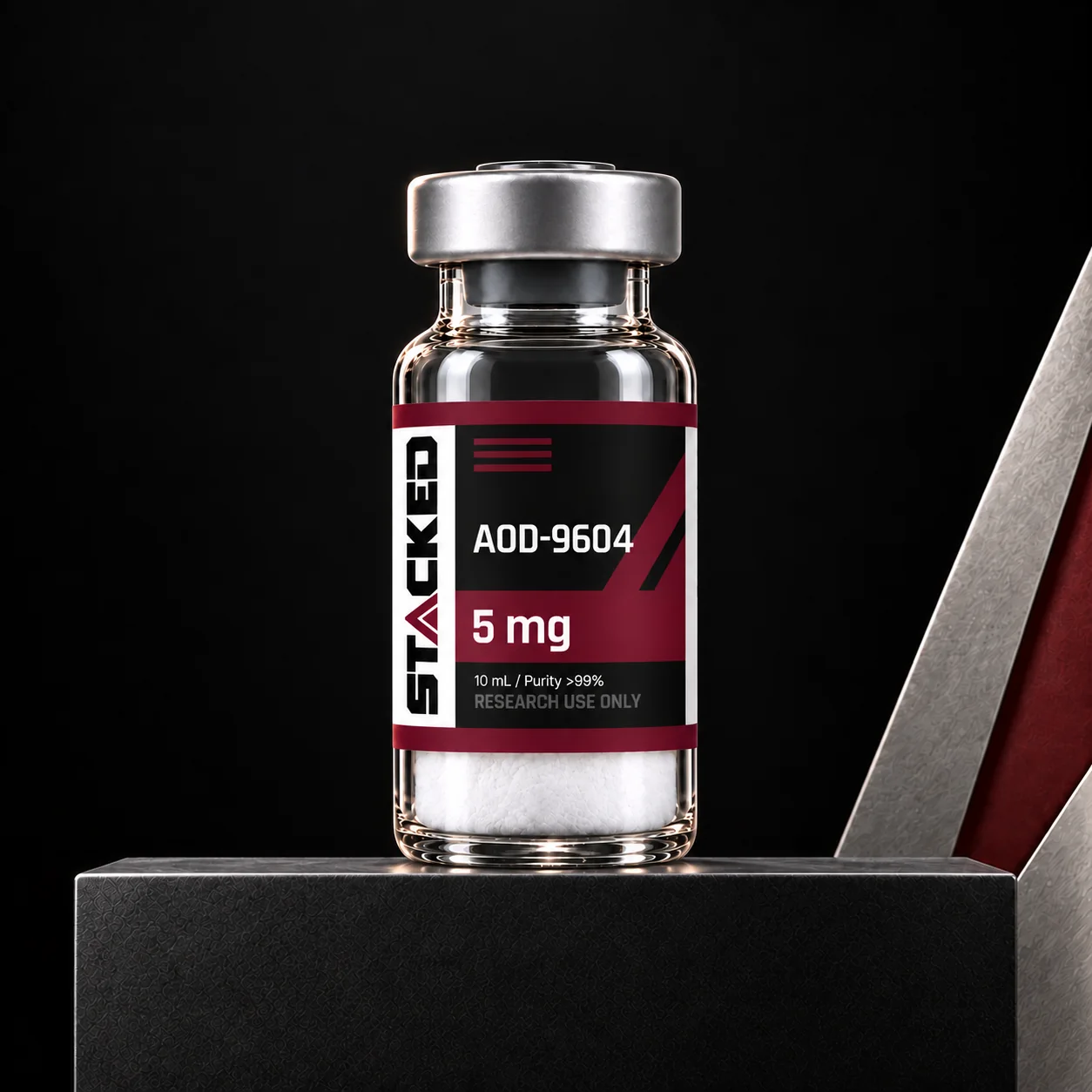
AOD-9604 (Tyr-hGH 177-191) is a modified 16-amino-acid fragment of human growth hormone, designed to isolate the fat-metabolism activity of that region without the hormone’s growth-promoting effects. Supplied as lyophilized powder in a 5 mg vial, each lot with an HPLC certificate of analysis. CAS 221231-10-3. For laboratory research use only.
Certificate of analysisView available PDF reports
Product identification & intended use
SKU: STK-VIA-00050
For laboratory research use only. Not for human or veterinary use.
Description
AOD-9604 Vial: Research-Grade hGH Fragment 177-191 Analogue
AOD-9604 is a modified 16-amino-acid fragment of human growth hormone, based on the C-terminal region (residues 177–191) with an added N-terminal tyrosine. It was designed to isolate the fat-metabolism activity associated with that region of growth hormone, without the growth-promoting and insulin-related effects of the full hormone.
Stacked BioLabs supplies AOD-9604 as a lyophilized powder, 5 mg per vial, with a lot-specific certificate of analysis.
Compound identity
Research background
Researchers at Monash University in Australia observed in the 1990s that a fragment from the C-terminal end of growth hormone could influence fat metabolism in animal models. AOD-9604 was developed from that work, and was later taken forward by the Australian company Metabolic Pharmaceuticals.
Published studies in obese mice reported that it increased lipolysis and fat oxidation and reduced fat accumulation, including in mice lacking the β3-adrenergic receptor, suggesting a mechanism separate from classic adrenergic fat breakdown. Unlike full-length growth hormone, it did not raise IGF-1 or reduce insulin sensitivity in those models. Human trials for obesity were run in the 2000s but did not lead to approval for that use, and later research has also looked at cartilage and joint models.
AOD-9604 is a useful comparison compound in metabolic research alongside 5-Amino-1MQ, MOTS-c and SLU-PP-332, and in growth hormone research alongside tesamorelin.
Verifying your lot
Every vial carries a lot number. Match it to its certificate in the COA & lab reports library, which lists identity and purity results for that specific batch. A certificate applies only to the lot it names. If you can’t find a report for your lot, contact us and we’ll supply it. Keep the certificate in your lab records together with the product, strength and lot number, so every result can be traced back to the exact batch used.
A typical certificate reports purity by high-performance liquid chromatography (HPLC) and confirms identity by mass spectrometry (MS), comparing the measured molecular mass with the expected value for the compound. Check that the product name, strength and lot number on the certificate match the label before recording results.
Storage and handling
Lyophilized peptides are most stable when kept cold, dry and away from light; −20 °C is the standard for long-term storage of lyophilized material. Follow the storage instructions supplied with the material and your institution’s handling procedures. Reconstitution is usually done with sterile or bacteriostatic water, depending on your protocol. Before opening, let the vial reach room temperature to limit condensation, and use sterile technique when puncturing the stopper. Label each reconstituted vial with the date, diluent and concentration used, and keep it refrigerated and protected from light.
Frequently asked questions
How is AOD-9604 related to growth hormone?
It is a modified fragment of human growth hormone’s C-terminal region (177–191) with an added tyrosine at the N-terminus.
Does AOD-9604 raise IGF-1?
In published animal studies it did not raise IGF-1, unlike full-length growth hormone.
What strengths are available?
One size: 5 mg per vial.
Is this product for human use?
No. This product is sold strictly for laboratory research use. It is not a drug, food, dietary supplement or cosmetic, and is not for human or veterinary use. See our RUO policy.
References
1. Heffernan M, et al. The effects of human GH and its lipolytic fragment (AOD9604) on lipid metabolism following chronic treatment in obese mice and β3-AR knock-out mice. Endocrinology. 2001. PubMed
2. Further reading: PubMed literature on AOD-9604 · PubChem
